
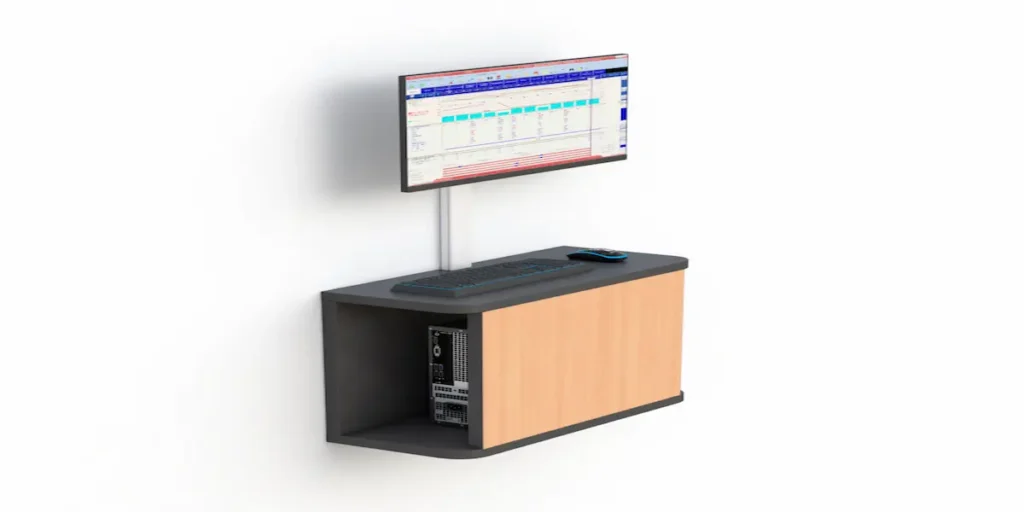
What Do You Need to Know Before Installing a Wall Mounted Computer Desk?
A wall mounted computer desk solves a floor-space problem. But it raises a different question: is the wall ready to hold it. A floor-standing desk doesn’t care what’s behind the wall. A wall mounted unit depends entirely on it. That’s the part most people don’t think about until installation day.
Before ordering one, walk through three things. What the wall needs to support. How much clearance the desk requires underneath. Where the cables and equipment will go once it’s up.
What Does Your Wall Need to Support a Desk Like This?
People skip this question most often, and it’s the one that causes problems later. A wall mounted desk needs to anchor into something structural: wall studs, a masonry wall, or a steel frame. Drywall or a thin partition won’t hold it.
Before ordering, confirm three things: what the wall is made of, where the structural points sit, and whether the desk’s mounting hardware matches that structure. Older facilities and temporary partition walls sometimes need a mounting plate or bracket system instead of a direct attachment. Check this before the desk arrives, not after.
How Much Clearance Do You Need Underneath?
The desk doesn’t rest on legs, so the space beneath it stays open. That’s the whole point, but you still need to plan for it. Think about what needs to fit under the desk: a rolling chair, a stool, someone’s knees while seated. Some setups need no clearance at all if the desk is meant for standing use only.
Some facilities install these desks at a fixed height for a mixed group of users. The clearance often works for some people and not others. If the station will be shared across shifts, consider a height-adjustable option instead of a fixed wall mounted unit.
Where Does the CPU and Cabling Go?
A wall mounted desk clears the floor, but the computer tower and cables still need somewhere to live. Most setups handle this one of two ways. Use a CPU wall mount beside or beneath the desk. Or add an enclosed computer cabinet nearby if the equipment needs protection from dust or moisture.
Plan cable routing before installation, not after. It saves a lot of rework. Power and data lines typically need to run to the mounting point itself. Confirm where those connections are available on the wall before finalizing placement.
When Does a Wall Mounted Desk Make More Sense Than a Floor Stand?
Both solve a similar problem, but they’re not interchangeable. A floor stand installs faster since it doesn’t depend on wall structure. You can also reposition it more easily if the layout changes later. A wall mounted desk works better when the floor beneath the station absolutely needs to stay clear: high-traffic aisles, forklift paths, or areas where a stand’s footprint would get in the way.
Will your layout likely change soon? A floor stand offers more flexibility. Is the layout settled with floor space as the priority? A wall mounted desk is usually worth the extra installation planning.
What Environments Benefit Most From This Setup?
Wall mounted desks show up most in facilities where floor space is genuinely scarce: warehouse mezzanines, narrow control room layouts, and production lines where every foot of aisle matters. They’re also common in cleanroom-adjacent areas, where minimizing anything on the floor reduces contamination risk. Facilities don’t choose this desk for style. They choose it because the floor underneath has a job that a standing desk would get in the way of.
Frequently Asked Questions
Does a wall mounted computer desk need to be attached to a stud?
Yes, in most cases. The desk needs to anchor into a structural point like a wall stud, masonry, or a steel frame rather than drywall alone. Confirm the wall structure before installation.
How much weight can a wall mounted computer desk typically hold?
Weight capacity depends on both the desk’s build and the wall’s structural support. Match the desk’s rated capacity to what the wall can actually bear, not just what the desk itself is rated for.
Can a wall mounted computer desk be installed on drywall alone?
Not safely on its own. Drywall typically can’t support a wall mounted desk without anchoring into studs or adding a reinforced mounting plate behind it.
Is a wall mounted desk better than a floor stand for a warehouse?
It depends on the layout. A wall mounted desk works better when the floor beneath the station needs to stay completely clear. A floor stand offers more flexibility if the layout might change later.
Where does the CPU go with a wall mounted computer desk?
Most setups pair the desk with a CPU wall mount positioned nearby, or an enclosed computer cabinet if the equipment needs protection from dust or moisture.