
How Do You Protect Industrial Computer Equipment That Can’t Afford to Fail?
If a computer tower has ever failed early because it sat exposed on a dusty production floor, you already know why computer cabinets exist. Standard equipment can’t handle industrial environments. Dust, temperature swings, vibration, and moisture make a facility productive. Those same conditions shorten the life of unprotected electronics.
A computer cabinet solves this. It fully encloses the equipment in a housing that handles those conditions, instead of leaving a tower or CPU exposed on a shelf or desk. The right cabinet depends on what you’re protecting against and where the equipment needs to sit.
What Does a Computer Cabinet Actually Protect Against?
Most industrial computer cabinets guard against one or more of the following:
- Dust and debris, which can clog fans and cause overheating over time.
- Moisture and humidity, which corrodes internal components and connections.
- Temperature swings, especially in facilities without consistent climate control.
- Physical impact or vibration, common near heavy machinery or forklift traffic.
Know which of these your facility deals with most. That’s the fastest way to narrow down which cabinet style makes sense. Don’t choose based on size or price alone.
Where Should Your Computer Cabinet Be Mounted?
This depends heavily on your floor plan and how much ground-level space you can spare.
If floor space is limited, pair a cabinet with a CPU wall mount. This keeps the equipment off the ground entirely and mounts it to a wall or nearby structure instead. Warehouses and tight production lines commonly use this setup, since every foot of floor matters.
If the cabinet is part of a larger fixed station, pair it directly with a wall mounted computer desk or an industrial workbench. That way the enclosure sits right at the point of use, not somewhere separate from the operator.
Do You Need a Cabinet If Your Equipment Is Already Mounted?
This is a common misconception. Mounting equipment off the floor solves the space problem, but it doesn’t solve the exposure problem. A CPU wall mount keeps a tower secure and accessible, but it can’t protect it from dust or moisture on its own. You need to pair it with an enclosed cabinet.
Does your facility run cleanrooms, food production, or any environment with strict contamination controls? Then an enclosed cabinet isn’t optional. It keeps sensitive electronics compliant and reliable in that setting.
How Does This Fit Into a Full Workstation?
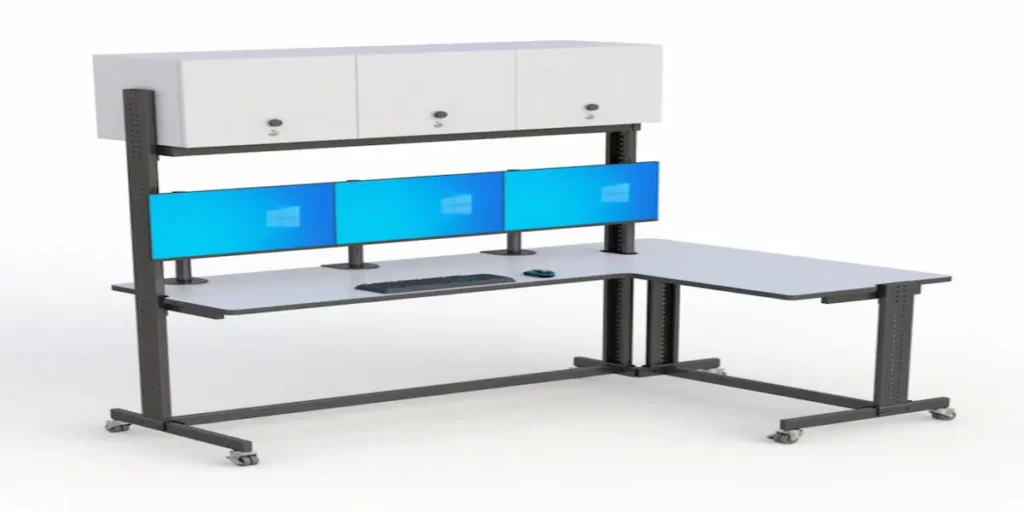
A computer cabinet is rarely the only piece of an industrial setup. A typical station might use a ceiling mounted monitor arm for the screen, a nearby cabinet for the CPU, and either a fixed desk or a mobile cart as the base. The right base depends on whether the work happens in one spot or across multiple stations. Treat the cabinet as one part of that larger system, not a standalone purchase. That approach usually protects the equipment the way it’s meant to be protected.
Frequently Asked Questions
What is a computer cabinet used for in industrial settings?
It encloses and protects computer equipment from dust, moisture, temperature swings, and physical impact common in industrial or production environments.
Do I need a computer cabinet if my equipment is already wall mounted?
Yes, if your facility has dust, moisture, or contamination concerns. A wall mount keeps equipment off the floor, but only an enclosed cabinet protects it from environmental exposure.
What industries use computer cabinets most often?
Manufacturing, warehousing, food production, and cleanroom facilities commonly use computer cabinets to handle dust, temperature control, or contamination sensitivity.
Can a computer cabinet be paired with a CPU wall mount?
Yes. Pairing a cabinet with a CPU wall mount keeps the equipment off the floor and protected from environmental exposure at the same time.
How do I know which computer cabinet style fits my facility?
Identify which conditions your equipment faces most, such as dust, moisture, or vibration. Choose a cabinet built specifically to guard against those factors rather than a general-purpose enclosure.